Landscaping, landscape fabric, erosion control and contractor supplies
from Western Landscape and Geotextile Supply
Landscape Supplies
Erosion Control
Geotextiles
Polyester Spunbond Landscape Fabric
(retail and commercial)
Straw & Straw Coconut Blankets
Woven Fabrics, 200 & 300lb Tensile
Fiber Punched Woven Black Landscape Fabric
(retail and commercial)
Excelsior Blankets
Non-Woven Fabrics (4,6,8 oz.)
Steel and Galvanized Edging
(Homeowner and commercial)
Jute Mesh
Woven Groundcover
Edge Pins, galvanized and steel
Synthetic Turf Reinforcement
Winter Protection
Fabric Staples (assorted sizes)
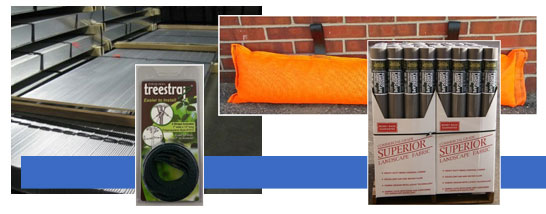
Sand Bags (Burlap & Poly)
Seed Germination Fabric (1/2 oz)
Tree Straps (12” and 16”)
Straw Wattles
Pond Liner Underlayment (4,6,8oz)
48” Hardwood Stakes, Pine Survery Stakes
Silt Fence
Safety Fence
Burlap Rolls and Bags
Hardwood Stakes
Customized Shade Cloth*
Woven Ground Cover
Straw and Excelsior Logs
Silt Fence Fabric
Winter Protection Blankets (2oz, 4oz, 6oz)
Curb Inlet Protection
Silt Fence with Stakes
Customized Shade Cloth
Pocketed Silt Fence
Seed Germination Fabric ½ oz.
Wire Reinforced Silt Fence
Steel “T” Posts 3’ & 5’ Raw 5’ Painted
Recycled Rubber Pavers
Dog-Bone 7/8 and 1 ¾ Red
* Green - Special Order
-Wholesale
Only-
What you
need to know about Landscape Fabrics.
How does one go about
selecting a landscape fabric? This is a question that has confounded
anyone who has found themselves needing a good solution to weed
control. About the only method available currently, is through the
comparison of fabric specifications published by each manufacturer.
The problem with this method is that most fabric specifications
pertain to construction applications rather than landscape. Consequently,
most of us become boggled down comparing specifications that have
little meaning for our intended purposes. We have tried to narrow
these specifications down to those that are most important to landscape
applications. In an effort to give a basis of comparison to the
products we have listed, we have added the Colorado Department of
Transportation specifications to our product comparison sheet.
We feel the
selection of a landscape fabric should be based on three areas of
consideration.
They are as
follows:
The fabric
should be strong enough to withstand the most vigorous stresses
of application, but no more. Any added strength is offset with
a reduction in water and air flow, and an unnecessary increase
in the price of the product.
The fabric
should have an even, and consistent distribution of fibers, and
a small enough opening size to keep weedy grasses from coming
up through the fabric. Contrary to popular belief, weeds and grasses
do not force their way through an obstacle, but rather grow to
the light that comes through the smallest of openings or breaks
that may exist. Weed seeds will also germinate in small accumulations
of soil on top of a fabric, and send tiny root hairs through the
smallest of openings to seek water and nutrients from the soil.
This problem is largely avoided with the use of spunbonded fabrics,
due to their almost microscopic opening size.
Finally the
fabric must be porous enough to allow water and air to pass freely
to the soil. We feel this is one of, if not the most important
characteristic of a superior landscape fabric. If a fabric does
not "breathe properly" plants do not get enough oxygen,
and soils become sour and sterile. This was the case when plastic
sheeting was being used as a weed preventative. Another disadvantage
of pour permeability is the problem of runoff. When a fabric does
not accept water freely it tends to wash off the fabric taking
any mulch covering, rock or bark, with it. This is a common problem
people have mistakenly blamed on the texture of the fabric surface.